

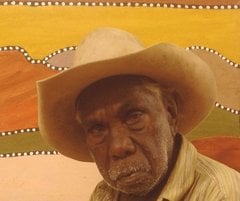
Beerbee Mungnari

FREE WORLDWIDE SHIPPING
FREE WORLDWIDE SHIPPING

100% MONEYBACK GUARANTEE
100% MONEYBACK GUARANTEE

LAYBY & PAY LATER PAYMENT OPTIONS
LAYBY & PAY LATER PAYMENT OPTIONS
Showing the single result
About the Artist
c. 1931 - 2011
Beerbee Mungnari (also known as Birribi Mungnari) was a highly respected senior Gija ochre artist and cultural knowledge holder from the East Kimberley region of Western Australia. Born at Waterloo Station in the Northern Territory, near the Western Australian border, Beerbee spent much of his life working as a stockman and drover across the cattle stations of the East Kimberley.
Beerbee grew up on Rosewood Station, where his family had longstanding connections. He recalled childhood visits to Waterloo Station at Christmas and growing up on a diet that included kangaroo soup and goat's milk. Rosewood was managed by the well-known Kimberley cattleman Jack Kilfoyle, and at approximately sixteen years of age, Beerbee began working at Texas Downs Station, where his father had connections with station manager Jimmy Cline.
Beerbee was never certain of his exact birth date, but he recalled being a 'young fella' during World War II when Japanese aircraft flew overhead. It was one of the memories he shared with Artlandish Aboriginal Art Gallery during the many years he worked with the gallery.
Over the following decades, Beerbee worked on numerous stations, including Rosewood, Texas Downs, Argyle, Lissadell, Old Argyle, Kildurk and other properties along the Western Australian and Northern Territory border. His work took him through extensive areas of Country, mustering cattle, establishing stock camps and travelling the long droving routes to Wyndham.
He recalled droving mobs of up to 700 cattle with small teams of stockmen, a camp cook and an offsider, travelling for many days across the Kimberley to the meatworks at Wyndham. These experiences gave Beerbee an intimate knowledge of the hills, rivers, crossings, waterholes and cattle yards that would later feature so prominently in his paintings.
Like many senior East Kimberley artists of his generation, Beerbee witnessed enormous changes to the landscape during his lifetime. The construction of the Ord River Dam and the creation of Lake Argyle submerged extensive areas of Country he had known and worked throughout his stockman years. Many of the places he later painted had disappeared beneath the waters of the lake, making his artworks important records of the landscape as he remembered it.
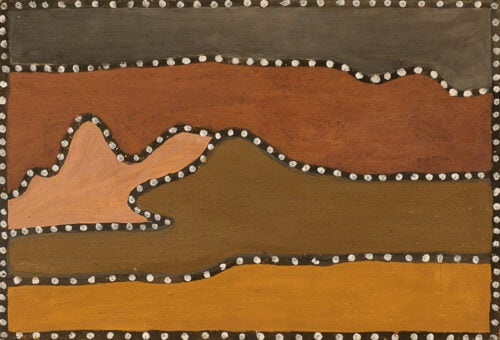
Beerbee began painting around 1982, during the early development of the East Kimberley ochre painting movement. He was influenced by senior artists including Jack Britten, whose painting techniques he observed and began experimenting with himself. Working with natural ochres gathered from Country, Beerbee developed a distinctive style characterised by strong compositions, carefully defined landforms and bold areas of contrasting earth colours.
His paintings frequently depict the country around Rosewood, Texas Downs, Old Argyle and the Ord River, recording important locations and the events associated with them. Stock routes, cattle yards, river crossings, camping places and the great hills of the East Kimberley became recurring subjects. His paintings are particularly valued for the personal histories they contain, providing a direct connection to his experiences as a stockman and his knowledge of Country before the development of Lake Argyle.
Beerbee was also closely involved with the early Warmun community school, where he painted stories to help teach younger generations about Country, history and culture. Some of these early paintings became part of the Warmun Community Collection. His commitment to sharing knowledge continued throughout his life.
Following his retirement from stock work, Beerbee spent time living in Wyndham, Warmun and Frog Hollow Community, where he maintained close friendships with fellow senior artists Jack Britten and Henry Wambini. He and his wife were also involved in teaching and supporting children at the Warmun school during its early years.
Painting became an important tradition within Beerbee's own family. His daughters Denise, Joanne and Marika Mung followed in his artistic footsteps, while his daughter Sade Carrington became an established Gija artist in her own right. His granddaughter Charlene Carrington also continued the family's ochre painting tradition. Through these generations, Beerbee's knowledge of Country and the stories associated with it have continued to be shared.
Beerbee's work gained recognition through exhibitions across Australia and internationally, including a solo exhibition at Alison Kelly Gallery in Melbourne in 2004. His paintings are represented in significant collections, including the National Gallery of Victoria, the Australian Parliament House Rotational Collection, the Nevada Museum of Art in the United States and the Kerry Stokes Collection.
Recognised as one of the senior male painters of the first generation of East Kimberley ochre artists, Beerbee remained committed to recording the Country he had known throughout his life. His distinctive paintings preserve not only the physical landscape but also the memories, history and experiences of a generation of Aboriginal stockmen whose lives were closely connected to the land.
Beerbee passed away on 20 December 2011, leaving an important artistic and cultural legacy within the East Kimberley.
SELECTED SOLO EXHIBITIONS
• 2004 Beerbee Mungnari, Alison Kelly Gallery, Melbourne, VIC
SELECTED GROUP EXHIBITIONS
• 2025 Eternal Signs: Indigenous Australian Art from the Kaplan & Levi Collection, Nevada Museum of Art, Reno, USA
• 2024–2025 We Were Lost in Our Country, Nevada Museum of Art, Reno, USA
• 2023 Ochre Painters of the Kimberley, Japingka Gallery, Fremantle, WA
• 2022 Homeland, Aborigène Galerie, Paris, France
• 2021 Rover Thomas & Kimberley Ochre Painters, Japingka Gallery, Fremantle, WA
• 2010 Beerbee Mungnari and Churchill Cann, Seva Frangos Art, Perth, WA
• 2010 Ochres of the Kimberley, Tunbridge Gallery, Margaret River, WA
• 2010 Warmun: Our Earth, Our Story, Art Images Gallery, Norwood, SA
• 2009 Bardungel: The Youngest One, Chapman Gallery, Canberra, ACT
• 2009 Ochre: A Study in Materiality, Short Street Gallery, Broome, WA
• 2008 Aboriginal Masterworks: Gala Opening, Gallery Sydney-East, Virginia, USA
• 2008 Warmun at Ten: A Decade of Warmun Art, Hogarth Galleries, Sydney, NSW
• 2008 New Voices in Gija Art, Gallery Gabrielle Pizzi, Melbourne, VIC
• 2007 From the Ground Up: Ochre Work from the Kimberley, Chapman Gallery, Canberra, ACT
• 2007 Warda-wurrarrem (All Kinds of Stars), Raft Artspace, Darwin, NT
• 2006 Gentlemen of Warmun, Seva Frangos Art, Perth
• 2005 Waterhole Country, Short Street Gallery, Broome, WA
• 2004 Tibet Meets Warmun, Fremantle Arts Centre, Fremantle, WA
• 2004 Big Country, Gallery Gondwana, Alice Springs, NT
• 2003 Three Old Men, Span Gallery, Melbourne, VIC
• 2002 Warmun Country, Flinders University Art Museum, Adelaide, SA
• 2002 New Works from Warmun, Gallery Gabrielle Pizzi, Melbourne, VIC
• 2002 Recent Works from Warmun, Framed Gallery, Darwin, NT
• 2002 Munumburra: Wise Men of Warmun, Artplace, Perth, WA
• 2001 Short on Size, Short Street Gallery, Broome, WA
SELECTED COLLECTIONS
• National Gallery of Victoria, Melbourne
• Australian Parliament House Rotational Collection, Canberra
• Nevada Museum of Art, USA
• Perth Children's Hospital Collection, Perth
• King Edward Memorial Hospital Collection, Perth
• City of Wanneroo Collection, Western Australia
• Kerry Stokes Collection
Current local time at Gallery
 Opening Hours
Saturday: 9:00AM - 12:00PM
Sunday: Closed
Call Us
 1300 362 551
 +61 8 9168 1881
Current local time at Gallery
-
Mon - Fri: 9:00AM - 4:00PM
Opening Hours
Saturday: 9:00AM - 12:00PM
Sunday: Closed -
Call Us
1300 362 551
+61 8 9168 1881



10 Papuana St, Kununurra,
Western Australia, 6743 Australia
