



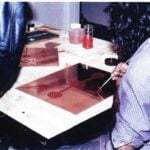

Clifford Possum Tjapaltjarri / Ngarlu Love Story (7-50)
SKU: CPT7-50
58cm x 63.4cm (paper), Image size 38.8cm x 48cm Sugar-lift aquatint etching on cotton paper, Limited Edition, 7/50, 1994 Printed by Australian Print Workshop, Melbourne
View more from artist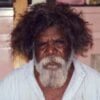



$3,550.00
58cm x 63.4cm (paper), Image size 38.8cm x 48cm Sugar-lift aquatint etching on cotton paper, Limited Edition, 7/50, 1994
Printed by Australian Print Workshop, Melbourne
In stock


How Artworks Are Sent

Acrylic paintings: Shipped rolled in a tube (unless otherwise stated)

Ochre paintings: Shipped stretched and boxed (unless otherwise stated)
Artist Profile
Clifford Possum was born in 1932 on Napperby Station. He worked extensively as a stockman on the cattle stations in and around his traditional country. During this time he developed an encyclopaedic knowledge of the Dreaming Trails that criss-cross the area to the north of the western McDonnell Ranges, which he depicts in painting his Dreamings.
His career as an artist began in the 50's when he carved snakes and goannas. By the 70's he was one of the most accomplished carvers in Central Australia. His first opportunity to paint came when one of Albert Namatjira's sons gave him acrylic paints and the master began his work. Clifford, living at the Papunya Community was one of the first artists to be involved with the Aboriginal Art Movement.
The art of Clifford Possum is notable for its brilliant manipulation of three-dimensional space. Many of his canvasses have strong figurative elements which stand out from the highly descriptive background dotting. In the late 70's he expanded the scope of Papunya Tula painting by placing the trails of several ancestors on the same canvas in the fashion of a road map. Within this framework, he depicted the land geographically. This laid the foundation for traditional Aboriginal Iconography to be placed on canvas. The other artist working with him took his lead and removed any elements of European Art from their work. In doing so Clifford, as well as the other artists involved with the Papunya Tula Movement helped to develop the true definition of Aboriginal Art, an art revolving around a culture, the Jukurrpa (Dreamtime).
In some of his stories Clifford attempts to give a visual impression of sunlight, cloud, shadow and earth to denote specific times of the day. His paintings show superlative skill, incredible inventiveness of form and are visually spectacular.
Clifford's work is contemporary but essentially Aboriginal in inspiration. To appreciate its full richness it is imperative that it is seen not only by its colour, composition and balance but by its mythological detail. One of the extraordinary qualities of Clifford's work and other Western Desert artists is that they are a visual writing and speak to the Aboriginal as books do to Europeans.
When asked why he became an Artist, he answered, "That Dreaming been all the time. From our early days, before European people came up. That Dreaming carry on. Old people carry on this law, business, schooling for the young people. Grandfather and grandmother, uncle and aunty, mummy and father, all that, they been carry on this, teach 'em all the young boys and girls. They been using the dancing boards, spear, boomerang all painted. And they been using them on body different times. Kids, I see them all the time, painted. All the young fellas they go hunting and the old people there, they do sand painting. They put down all the story, same like I do on canvas. All the young fella they bring 'em back kangaroo. Same all the ladies, they been get all the bush fruit, might be bush onion, plum, might be honey ants, might be yala, all the kungkas (women) bring them back. Because everybody there all ready waiting. Everybody painted. They been using ochres all the colours from the rock. People use them to paint up. I use paint and canvas that's not from us, from European people. Business time we don't use paints the way I use them, no we use them from rock, teach 'em all the young fellas."
Clifford is Australia’s most celebrated Aboriginal Artist of his time. He was the chairman of the Papunya Tula Artists from the 1970's to the 1980's. His work is featured in many of the main galleries and collections around Australia and Internationally – Collections include the National Gallery in Canberra and the New South Wales Art Gallery. His work has travelled extensively around the world, including, 'Dreamings' The Art of Aboriginal Australia in New York, Chicago, Los Angeles and St Louis. He has had a book published and dedicated to him and his paintings, 'The Art of Clifford Possum Japaltjarri', by Vivien Johnson. He is and has always been regarded as the leading figure in Australian Aboriginal Art.
Clifford passed away in Alice Springs on the 21st June 2002, just after being recognised for his contribution to Australian Art and Culture, by being made an "Officer of the Order of Australia". His final days where spent at the Hetty Perkins Nursing Home Alice Springs where he passed away surrounded by close family and friends.
He is sadly missed by those who worked with and knew him well, as well as art collectors and dealers around the world.
Selected Subjects and Themes
• Men's Ceremony, possum, fire, kangaroo, snake, fish, men's love story, lightning, goanna, water
Selected Awards & Commissions
• 1983, Alice Prize, Alice Springs NT
• 1985, Mural Design, Araluen Centre, Alice Springs
• 1991, Strehlow Research Foundation, Alice Springs
• 1991, Mural, new Alice Springs Airport
• Clifford Possum was the Chairman of Papunya Tula Artists during the late 1970s and early 1980s.
Selected Collections
• Artbank, Sydney
• Art Gallery of New South Wales, Sydney
• Art Gallery of South Australia, Adelaide
• Art Gallery of Western Australia, Perth
• Berndt Museum of Anthropology, University of Western Australia
• Broken Hill Art Gallery
• Donald Kahn collection, Lowe Art Museum, University of Miami
• Flinders University Art Museum, Adelaide
• National Gallery of Australia, Canberra
• National Gallery of Victoria, Melbourne
• Pacific Asia Museum, Los Angeles
• Parliament House Art Collection, Canberra
• Queensland Art Gallery, Brisbane
• South Australian Museum, Adelaide
• The Holmes a Court Collection, Perth
• The Kelton Foundation, Santa Monica, U.S.A.
Artwork Story
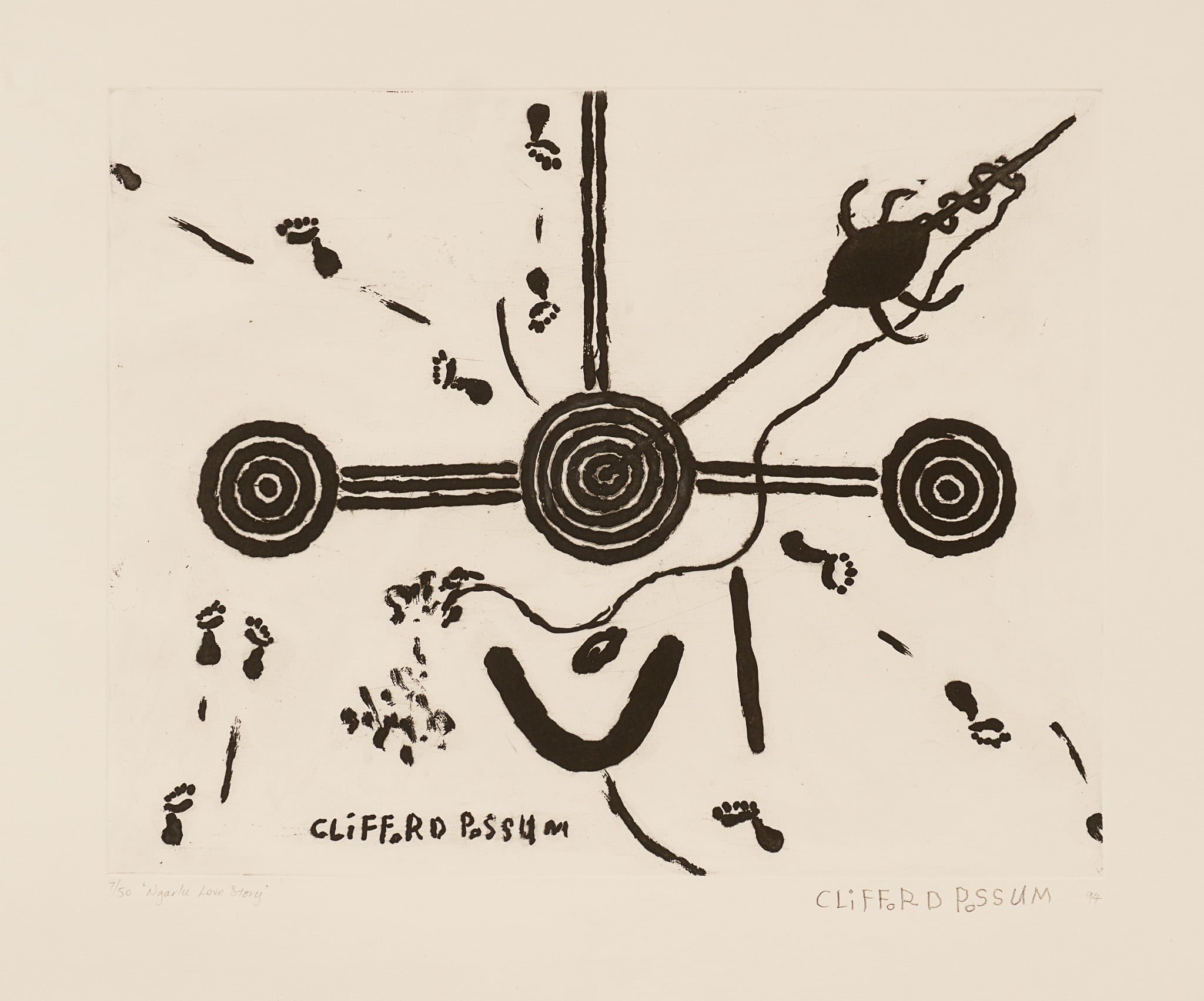
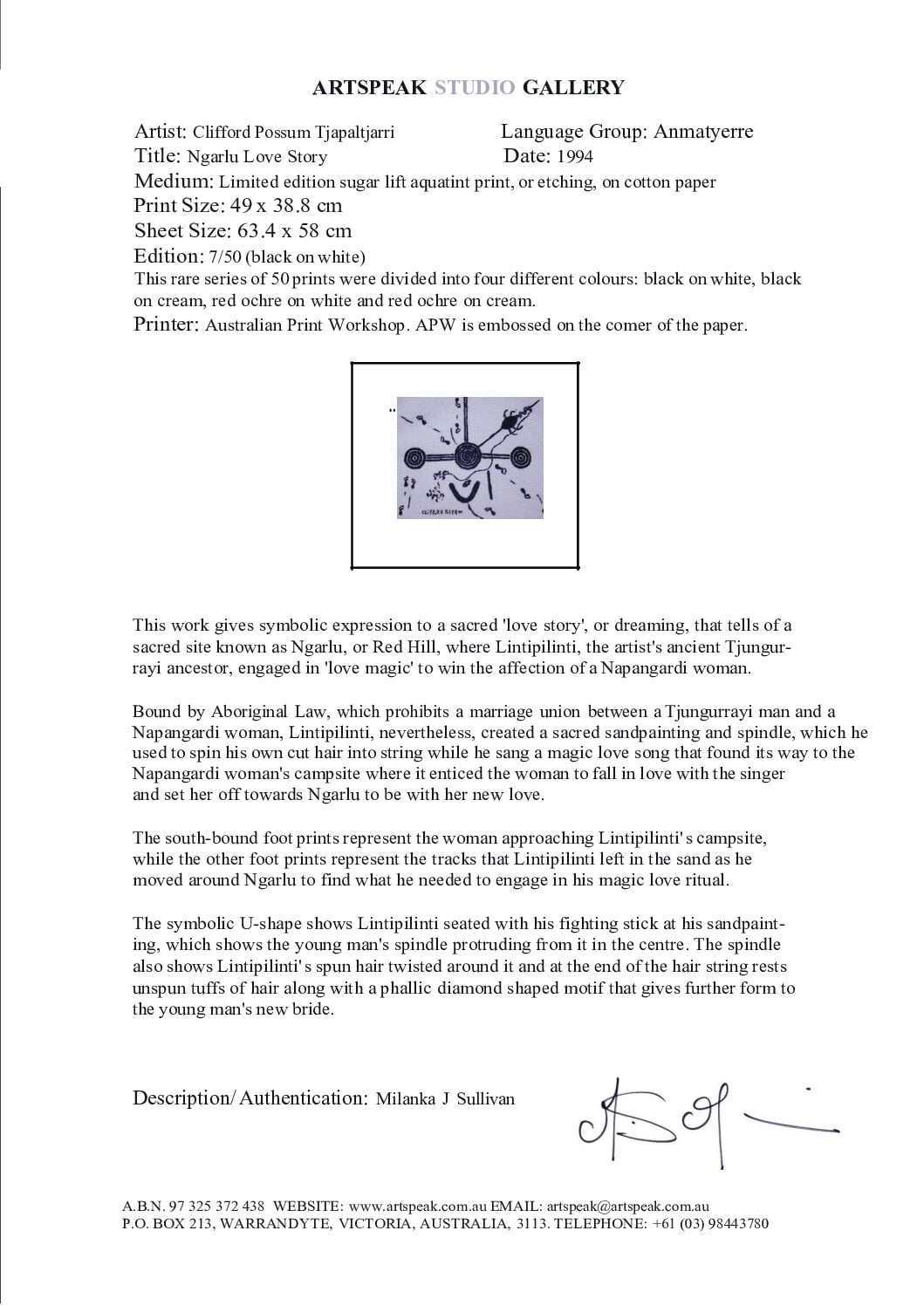
Ngarlu Love Story depicts an ancestral love story associated with the sacred site of Ngarlu, or Red Hill, on Clifford Possum Tjapaltjarri's ancestral Country.
The story centres on Lintipilinti, a Tjungurrayi man who fell in love with a Napangardi woman. Under Aboriginal Law, their skin groups were forbidden to marry, but Lintipilinti was determined to win her affection.
At Ngarlu, he prepared a sacred sandpainting and began performing love magic. Cutting strands of his own hair, he spun them into a length of string using a spindle while singing a powerful love song. Carried towards the woman's campsite, his song drew her to him, and she began travelling towards Ngarlu.
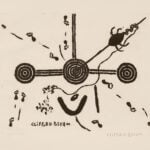
The central circular design represents the sandpainting, with the spindle and its long length of twisted hair string extending from it. Lintipilinti is represented by the U-shaped symbol, seated beside his fighting stick. The footprints scattered throughout the composition record his movements around Ngarlu as he gathered the materials for his love magic, along with the approaching footsteps of the Napangardi woman.
The finely balanced arrangement of circles, tracks and symbolic forms is characteristic of Clifford Possum's ability to convey complex ancestral stories through a distinctive visual language.
About this limited edition print
Created in 1994, Ngarlu Love Story is an original, limited edition sugar-lift aquatint etching produced at the Australian Print Workshop in Melbourne.
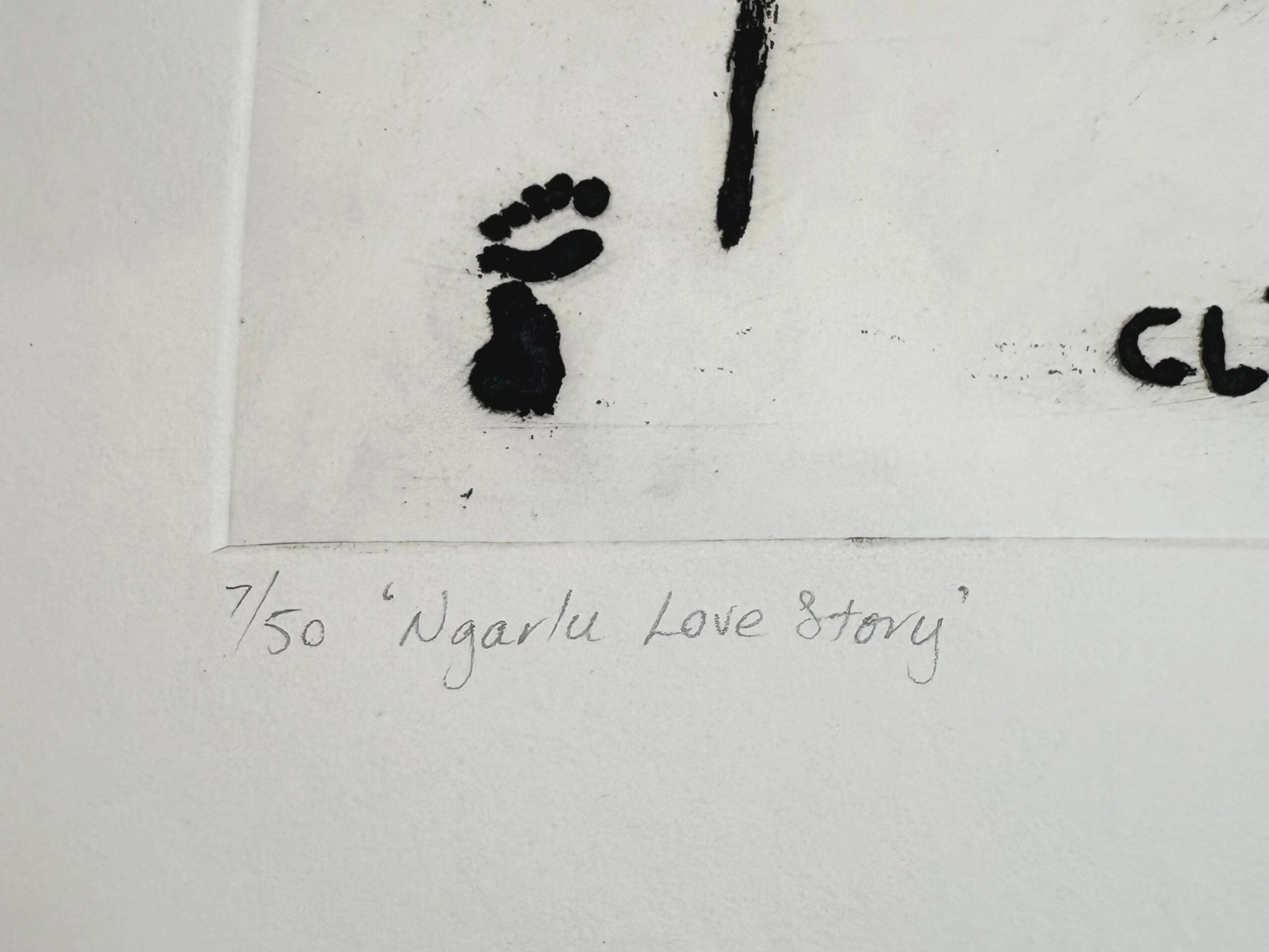
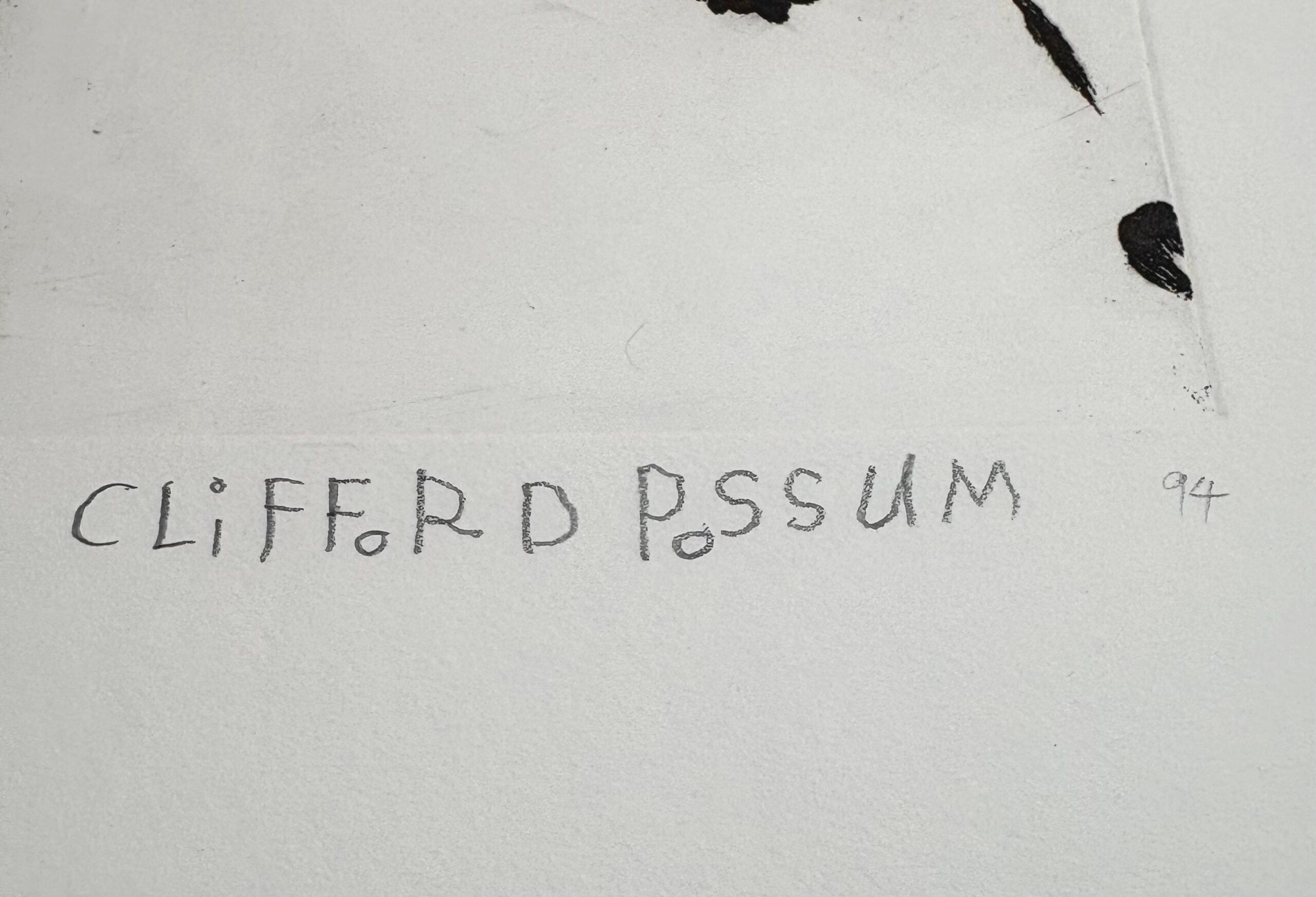
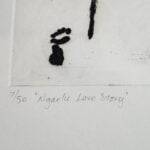
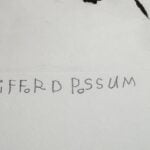
The work was printed from a copper plate onto fine art cotton paper. This impression is numbered 7/50 in the lower left margin and is signed and dated 1994 by Clifford Possum in the lower right margin. The artist's name also appears within the etched composition.
The series was produced in four colour variations: black on white, black on cream, red ochre on white and red ochre on cream.
This impression is the black-on-white version.
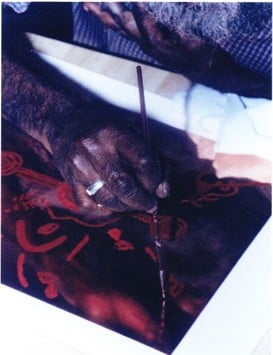
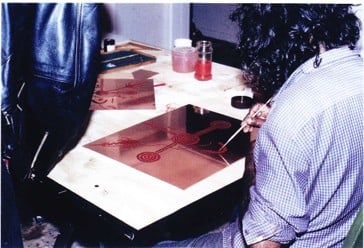
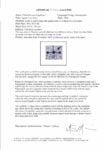
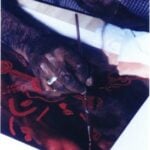
The artwork is accompanied by an Artspeak Studio Gallery Certificate of Authenticity, signed by Milanka J. Sullivan. The documentation includes historical photographs of Clifford Possum working with printmaker Martin King at the Australian Print Workshop, photographed by Frank Mosmeri.
Shipping, Returns & Exchanges
Shipping & Insurance is 100% Free Worldwide
Note: Some countries & local jurisdictions may charge import customs fees. Please check with your local customs office. Free shipping does not include any additional import duties, taxes or fees.
Guarantee & Refunds:All artworks come with a 30-day 100% money back guarantee.
If, for whatever reason, on delivery of your artwork(s), you are not satisfied with your acquisition, you may return the artworks(s) for a full refund of the purchase price.
When requesting a refund all return shipping charges are to be borne by the customer and as all goods are the responsibility of the customer until they are received by us, we highly recommend that you insure the goods to be returned to the value of the purchase price.
This can usually be done easily through your local postage service or courier.
Exchanges:The Artlandish 30-day exchange program means you may also swap your artwork(s) with something else up to the value of the originally purchased painting(s).
Simply notify Artlandish within 30 days of receiving your artwork that you wish to exchange it for another piece and then return the artwork to be exchanged.
The new artwork(s) chosen via exchange also enjoy Free worldwide shipping! You will only have to cover the return shipping costs of the artwork you wish to exchange.
If you have any other questions or concerns , please don't hesitate to contact us at any time.
For more information and full details please see our refunds and returns policy page , money back guarantee page and our shipping page


 Opening Hours