


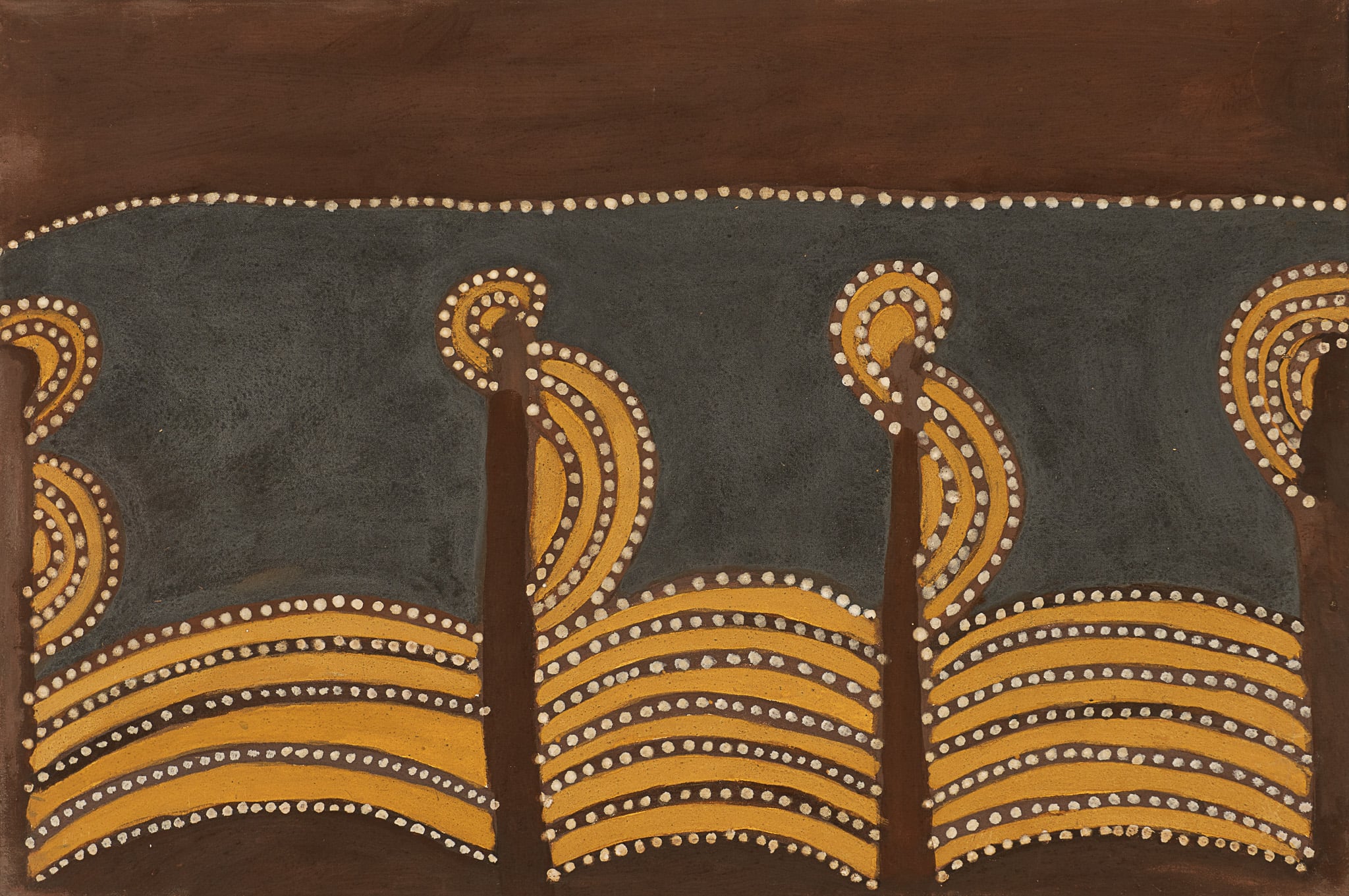



Jack Britten / Gwoliny (N-0856-JB)
SKU: N-0856-JB
60cm x 90cm Ochre on Canvas, 1999
View more from artist


$4,800.00
60cm x 90cm Ochre on Canvas, 1999
In stock


How Artworks Are Sent

Acrylic paintings: Shipped rolled in a tube (unless otherwise stated)

Ochre paintings: Shipped stretched and boxed (unless otherwise stated)
Artist Profile
c. 1921 – 2002
Jack Britten was a highly respected senior Gija lawman, Traditional Custodian and one of the pioneering artists of the East Kimberley ochre painting movement. Renowned for his distinctive depictions of Purnululu (the Bungle Bungles), his paintings reflect an intimate knowledge of Country, its ancestral stories, ceremonial traditions and history.
Jack was born around 1921 at Garnawarranginy, in the country around Alice Downs Station, and spent much of his childhood at Tickelara in the East Kimberley. Growing up during a period of significant upheaval for Aboriginal people, he developed a deep knowledge of his ancestral lands through his family and the generations of Gija people who came before him.
Like many Aboriginal men of his generation, Jack began working on cattle stations at an early age. He became an accomplished stockman and drover, working across the East Kimberley and travelling considerable distances throughout Australia, including along the Canning Stock Route, to Alice Springs and as far east as Central Queensland. He possessed an extraordinary memory for people, places and events, and his recollections of station life and the characters he encountered were accompanied by a wonderful sense of humour. His storytelling was as memorable as his painting.
After many years of station work and other employment, Jack returned to live on his traditional lands. In 1982, he helped establish the Wurreranginy community, better known as Frog Hollow, south of Warmun (Turkey Creek). He painted there for many years alongside fellow senior artists and longstanding friends Henry Wambini and Beerbee Mungnari. Affectionately known as "The Old Man from Frog Hollow", Jack remained closely associated with the community throughout his later life.
Jack's artistic knowledge extended back to childhood, when his grandparents taught him traditional painting methods, the preparation of natural pigments and the ceremonial designs of his culture. During the emergence of the East Kimberley contemporary ochre painting movement in the 1980s, he developed his practice alongside artists including Paddy Jampinji, George Mung Mung and Rover Thomas.
His paintings are distinguished by their powerful compositions, rich natural ochres and distinctive use of white dotting, curved lines and ceremonial markings. Jack was particularly celebrated for his interpretations of Purnululu, depicting its extraordinary sandstone domes as rhythmic clusters of rounded hills and undulating forms. His paintings frequently incorporate changing perspectives, combining aerial or topographical views of Country with more recognisable landscape formations.
The significance of Jack's depictions of Purnululu was further recognised when his 1988 painting Purnululu (Bull Creek Country), held in the collection of the National Gallery of Australia, was featured on the cover of the Australian Government's 2002 nomination of Purnululu National Park for World Heritage listing. The park was subsequently inscribed on the UNESCO World Heritage List in 2003.
While Purnululu became his most widely recognised subject, Jack painted an extensive range of Country, including Tickelara, Hann Springs, Mabel Downs, Lissadell, Texas Downs, Frog Hollow and the upper reaches of the Ord River. His artworks reveal both the physical characteristics of these places and their deeper significance within the Gija Ngarrangkarni (Dreaming).
Jack retained a strong connection to traditional painting materials and techniques. His early works employed natural ochres mixed with binders such as bloodwood gum, plant resins and kangaroo blood. He also recalled the practical challenges faced by the pioneering ochre artists, including the difficulties of painting on unstretched canvas in the intense Kimberley heat and the early use of plywood boards to support their paintings.
Beyond his considerable artistic achievements, Jack was a respected cultural teacher who understood the importance of passing traditional knowledge to younger generations. He believed that Gija culture would continue through ceremony, singing, dancing and the stories preserved in paintings. His work was therefore not simply a representation of landscape, but a means of maintaining and communicating the cultural knowledge of his people.
From the late 1980s, Jack exhibited extensively throughout Australia and internationally. His work featured in significant exhibitions including Crossroads: Towards a New Reality in Japan in 1992 and Images of Power: Aboriginal Art of the Kimberley at the National Gallery of Victoria in 1993. In 1992, he received the prestigious Museums & Art Galleries Award at the National Aboriginal Art Award for his painting Tickelara Country.
His paintings are represented in major public, private and corporate collections throughout Australia and overseas, including the National Gallery of Australia, National Gallery of Victoria, Art Gallery of Western Australia and Museum and Art Gallery of the Northern Territory. In 2004, he was recognised among Australia's Top 50 Most Collectable Artists.
Jack holds a particularly special place in the history of Artlandish Aboriginal Art Gallery. He was one of the first artists to work with the gallery's founder, with whom he developed a close and treasured friendship. His remarkable stories, warmth, humour and generosity of spirit left a lasting impression. At the time of his passing in July 2002, Jack was working on a painting for her. That artwork remains unfinished and is still treasured by the family, a poignant reminder of the artist and the friendship they shared.
Jack Britten's legacy extends far beyond his celebrated paintings. Through his art, cultural leadership and commitment to sharing the knowledge of his ancestors, he made an enduring contribution to the preservation of Gija culture and the recognition of East Kimberley Aboriginal art.
SELECTED AWARDS
• 1992 Museums & Art Galleries Award, 9th National Aboriginal Art Award, Museum and Art Gallery of the Northern Territory, Darwin, for Tickelara Country
SELECTED COLLECTIONS
• National Gallery of Australia, Canberra
• National Gallery of Victoria, Melbourne
• Art Gallery of New South Wales, Sydney
• Art Gallery of South Australia, Adelaide
• Art Gallery of Western Australia, Perth
• Museum and Art Gallery of the NT, Darwin
• Artbank, Australia
• Gifu Museum, Japan
• The Holmes à Court Collection, Perth
• The Kelton Foundation, Santa Monica, USA
• Kerry Stokes Collection, Perth
• The University of Western Australia Anthropology Collection, Perth
SELECTED EXHIBITIONS
• 2015 Indigenous Art: Moving Backwards into the Future, National Gallery of Victoria, Melbourne
• 2013 Australia, Royal Academy of Arts, London, United Kingdom
• 2010 East Kimberley Painting Revisited: Rover Thomas, Freddie Timms, Rusty Peters and Jack Britten, Michael Reid Gallery, Sydney
• 2002 Hector Jandany & Jack Britten, Vivien Anderson Gallery, Melbourne
• 1999 Images in Ochre, Cooee Aboriginal Art Gallery, Sydney
• 1997 Imaging the Land, National Gallery of Victoria, Melbourne
• 1994 Power of the Land: Masterpieces of Aboriginal Art, National Gallery of Victoria, Melbourne
• 1993 Images of Power: Aboriginal Art of the Kimberley, National Gallery of Victoria, Melbourne
• 1992 Crossroads: Towards a New Reality, Aboriginal Art from Australia, National Museums of Modern Art, Kyoto and Tokyo, Japan
• 1992 9th National Aboriginal Art Award Exhibition, Museum and Art Gallery of the Northern Territory, Darwin
• 1990 Balance 1990: Views, Visions, Influences, Queensland Art Gallery, Brisbane
• 1989 Turkey Creek Recent Work, Deutscher Gertrude Street, Melbourne
• 1988 Art of the East Kimberley, Birrukmarri Gallery, Perth
Artwork Story
In this striking ochre painting, Jack Britten depicts Gwoliny, the distinctive pale limestone formations found within his traditional Country in the East Kimberley region of Western Australia.
Throughout this ancient landscape, limestone ridges emerge from the surrounding Country, sometimes extending for many kilometres before disappearing beneath the earth again. Rising to heights of approximately 30 to 40 metres in places, these formations vary in colour from dark grey and black to pale, almost white limestone. Jack referred to the lighter formations as Gwoliny.
Shaped and weathered over countless wet and dry seasons, the exposed limestone forms an extraordinary feature of the East Kimberley landscape. Jack captures these formations through a series of sweeping, curved ochre bands, rising vertical shapes and carefully placed white dots. The rich yellow ochres contrast beautifully with the deep browns and charcoal greys, creating a powerful, rhythmic composition that reflects the distinctive character of the Country.
A highly respected senior Gija lawman and Traditional Custodian, Jack possessed an intimate knowledge of the landscapes he painted. Having spent much of his life living, hunting, travelling and working throughout the region, he knew its hills, ridges, creeks and significant places in remarkable detail.
His paintings reflect not only the physical appearance of Country but also the cultural knowledge and ancestral stories connected to these places. Through his distinctive use of natural ochres, strong forms and traditional markings, Jack created works that express his lifelong connection to the land and his commitment to preserving the knowledge of his ancestors.
Provenance
Narrangunny Art Traders, Western Australia
This painting has remained in the private collection of Narrangunny Art Traders since its creation in 1999 and has never previously been sold. It is now being offered for sale through Artlandish Aboriginal Art Gallery and is accompanied by its original Narrangunny Art Traders Certificate of Authenticity.
Narrangunny Art Traders has a long and respected association with the early East Kimberley ochre painting movement. They developed close relationships with many of the region's pioneering artists, including Jack Britten, Rover Thomas, Hector Jandany and Queenie McKenzie. Their longstanding involvement with these artists and their families has given Narrangunny a particularly strong connection to the history of East Kimberley Aboriginal art.
Shipping & Returns
Shipping & Insurance is 100% Free Worldwide
Note: Some countries & local jurisdictions may charge import customs fees. Please check with your local customs office. Free shipping does not include any additional import duties, taxes or fees.
Guarantee & Refunds:All artworks come with a 30-day 100% money back guarantee.
If, for whatever reason, on delivery of your artwork(s), you are not satisfied with your acquisition, you may return the artworks(s) for a full refund of the purchase price.
When requesting a refund all return shipping charges are to be borne by the customer and as all goods are the responsibility of the customer until they are received by us, we highly recommend that you insure the goods to be returned to the value of the purchase price.
This can usually be done easily through your local postage service or courier.
Exchanges:The Artlandish 30-day exchange program means you may also swap your artwork(s) with something else up to the value of the originally purchased painting(s).
Simply notify Artlandish within 30 days of receiving your artwork that you wish to exchange it for another piece and then return the artwork to be exchanged.
The new artwork(s) chosen via exchange also enjoy Free worldwide shipping! You will only have to cover the return shipping costs of the artwork you wish to exchange.
If you have any other questions or concerns , please don't hesitate to contact us at any time.
For more information and full details please see our refunds and returns policy page , money back guarantee page and our shipping page
Artworks By The Same Artist
-
 Jack Britten / Biddgullang (JB-077) $5,800.00


 Opening Hours